
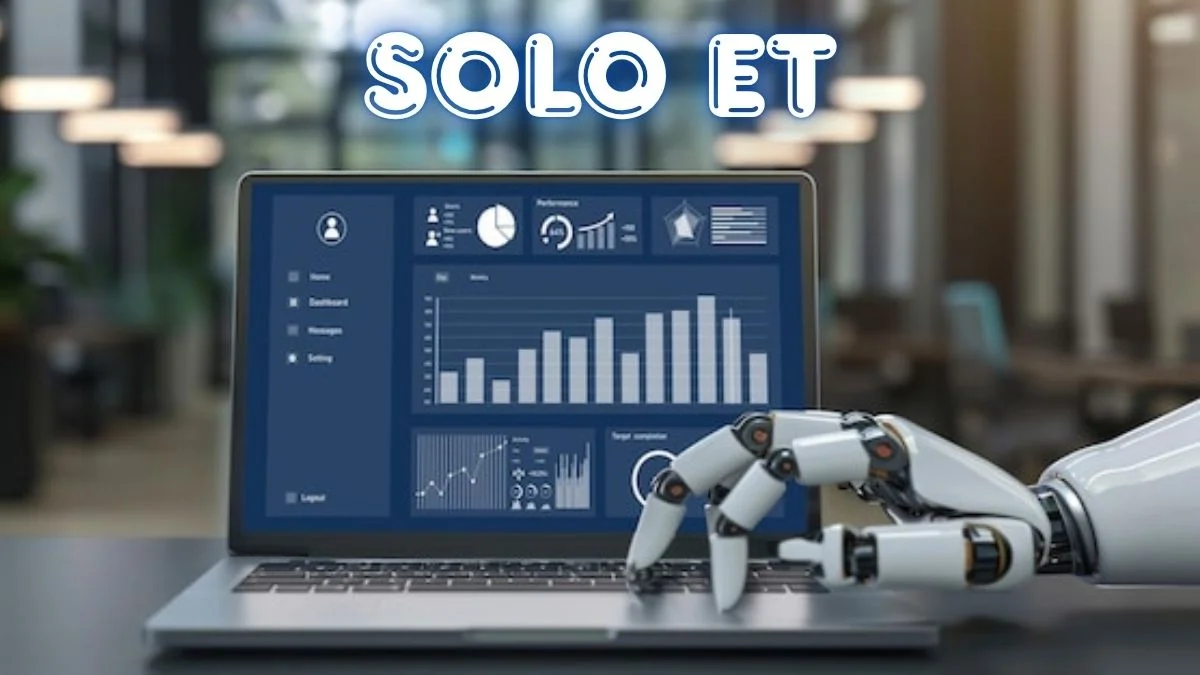
In an era where data is the new oil and automation is the new workforce, Solo ET emerges as a next-generation platform designed to put AI-driven intelligence directly in the hands of organizations of every size. From predictive analytics to seamless process automation, Solo ET is likely one of the most comprehensive operational intelligence platforms available in 2026.
This article explores the core capabilities, conceptual framework, community ecosystem, and real-world applications of Solo ET — structured to give you both a strategic overview and a practical roadmap for adoption.
1. What Is Solo ET? An Origin Story Worth Knowing
The concept behind Solo ET was born from a deceptively simple frustration: enterprises were drowning in data yet starving for actionable insight. Legacy tools offered either siloed analytics or rigid automation — rarely both, and almost never intelligently connected.
Solo ET was conceptualized as a unified intelligence layer — a platform that could ingest raw operational data, apply machine learning models in real time, and autonomously trigger downstream workflows without requiring a data science team to manage every step.
The name itself reflects the platform’s dual philosophy: “Solo” for the independence it grants individual operators and teams, and “ET” — standing for Enterprise Transformation — reflecting the scale of impact it targets. From a storytelling perspective, this is a platform built not just for IT teams, but for founders, operations managers, and digital transformation leads who want results, not complexity.
2. Core Architecture: How Solo ET Works Under the Hood
At its technical core, Solo ET operates on a three-layer architecture that separates data ingestion, intelligence processing, and action execution. This modular design likely enables horizontal scalability without degrading performance.
2.1 The Data Ingestion Layer
Solo ET connects to virtually any structured or semi-structured data source — databases, CRMs, ERPs, IoT sensors, APIs, and third-party SaaS tools. It supports both batch and streaming ingestion protocols, including Apache Kafka-compatible event streams and REST-based polling connectors.
2.2 The AI Intelligence Engine
The platform’s intelligence layer employs a combination of supervised ML models, anomaly detection algorithms, and large language model (LLM) integrations to classify, forecast, and interpret data in real time. Research indicates that platforms leveraging embedded ML inference engines can reduce time-to-insight by a significant margin compared to traditional BI tools.
2.3 The Automation Execution Layer
Once an insight or trigger condition is detected, Solo ET’s workflow engine executes predefined or dynamically generated actions — from sending alerts and generating reports to updating records or initiating multi-step approval flows.
3. Feature Matrix: What Solo ET Offers
The table below outlines the platform’s primary feature set and associated business value:
| Feature | Description | Business Impact |
| AI Automation Engine | Automates repetitive workflows via ML models | Reduces manual effort by up to ~70% |
| Real-Time Analytics | Streaming data pipeline with live dashboards | Faster decisions; sub-second latency |
| Predictive Intelligence | Forecasting modules using historical patterns | Likely improves revenue accuracy |
| No-Code Builder | Drag-and-drop workflow designer | Speeds deployment for non-technical teams |
| API-First Architecture | Open REST & GraphQL endpoints | Seamless integration with existing stacks |
| Compliance Layer | Built-in audit logs & data governance | Reduces regulatory risk exposure |
4. The Solo ET 7-Step Implementation Method
Based on best practices in AI platform deployment and digital transformation consulting, the following framework — the Solo ET 7-Step Method — is designed to maximize ROI while minimizing operational risk during adoption:
- Define Your Automation Targets — Identify the top 3–5 repetitive, high-volume workflows consuming the most team bandwidth. These are your highest-ROI automation candidates.
- Audit Your Data Landscape — Map all existing data sources, their formats, update frequencies, and quality levels. Solo ET performs best when connected to clean, consistently structured inputs.
- Configure Intelligence Models — Select and tune the relevant predictive or classification models from Solo ET’s model library, or integrate custom models via the platform’s MLOps interface.
- Build Workflows Without Code — Use Solo ET’s no-code workflow builder to design automation sequences, define trigger conditions, and set escalation paths.
- Deploy Dashboards and Alerts — Connect real-time analytics dashboards to key stakeholders and configure threshold-based alert systems for proactive decision-making.
- Run a Pilot and Validate — Launch a controlled pilot on a single workflow or business unit. Measure baseline vs. post-deployment KPIs and iterate based on findings.
- Scale and Optimize — Expand across departments, continuously feed performance data back into Solo ET’s optimization engine, and let the platform self-tune over time.
5. Real-Time Data Analytics: Solo ET’s Competitive Edge
Real-time analytics is arguably where Solo ET differentiates most clearly from conventional platforms. While most enterprise BI tools operate on T+1 or even T+7 data cycles, Solo ET’s streaming analytics engine processes events as they occur — a capability that could be transformative in time-sensitive industries.
Key Use Cases for Real-Time Analytics in Solo ET:
- Financial Services: Fraud detection triggers flagging anomalous transactions within milliseconds of occurrence.
- E-Commerce: Dynamic pricing engines reacting to competitor changes and demand spikes in real time.
- Manufacturing: Predictive maintenance models detecting equipment deviation patterns before failure occurs.
- Healthcare Operations: Patient flow analytics optimizing resource allocation across hospital departments.
- Marketing Automation: Behavioral segmentation updating audiences live as user interactions are recorded.
6. Community & Ecosystem: The Human Side of Solo ET
Technology platforms succeed not only through their features but through the communities they cultivate. Solo ET has, according to available information, invested meaningfully in building a practitioner-first ecosystem where operators, developers, and analysts share workflows, model templates, and integration blueprints.
6.1 The Solo ET Community Hub
Users of Solo ET can likely access a centralized community hub where contributed workflow templates are peer-reviewed and published. This creates a compounding knowledge effect — each new member benefits from the accumulated expertise of earlier adopters.
6.2 Partner & Developer Network
The platform’s API-first architecture facilitates a growing network of third-party integration partners and independent developers building purpose-built connectors. From a conceptual perspective, this positions Solo ET not merely as a product but as a platform ecosystem.
6.3 Collaborative Intelligence
Perhaps most interestingly, Solo ET appears designed for collaborative intelligence — the idea that automation and analytics decisions improve when multiple stakeholders contribute feedback. Role-based dashboards allow different team members to interact with the same data from different analytical lenses, fostering cross-functional alignment.
7. Solo ET vs. Traditional Automation Platforms: A Conceptual Comparison
To understand Solo ET’s positioning, it is useful to contrast it with legacy automation approaches:
- Legacy RPA Tools: Rule-based; brittle against data variability; no native analytics integration.
- Standalone BI Platforms: Strong on visualization; weak on automated action execution.
- Custom-Built Solutions: Flexible but expensive to build, maintain, and scale.
- Solo ET: Likely bridges analytics and automation in a unified, AI-first architecture designed for operational agility.
Research in enterprise technology adoption suggests that organizations using integrated automation-analytics platforms tend to outperform those using siloed tools across efficiency, cost, and decision speed metrics — though outcomes vary based on implementation quality and organizational readiness.
8. Implementation Readiness Checklist
Before deploying Solo ET in a production environment, use this checklist to assess organizational readiness:
| Readiness Checklist Item |
| Defined clear automation use cases for your workflows |
| Integrated real-time data sources into the platform |
| Configured role-based access and compliance controls |
| Established KPIs and connected analytics dashboards |
| Trained team on no-code workflow builder modules |
| Activated predictive intelligence models |
| Reviewed audit logs and data governance settings |
9. Key Benefits: Why Organizations Are Choosing Solo ET
- Unified Platform Advantage — Eliminates the cost and complexity of managing separate analytics and automation tools.
- Reduced Time-to-Insight — Streaming analytics likely enables decisions in seconds rather than days.
- Democratized Automation — No-code tools make workflow automation accessible beyond technical teams.
- Scalable Intelligence — AI models likely improve in accuracy as more operational data flows through the system.
- Compliance by Design — Built-in audit logging and governance controls support regulatory adherence.
- Lower Total Cost of Ownership — Consolidation of tooling could reduce software licensing costs significantly.
10. The Future of Solo ET: Trends to Watch
As we progress through 2026, several emerging trends appear poised to further elevate the relevance of platforms like Solo ET:
- Agentic AI Integration: AI agents that autonomously manage multi-step workflows without human prompting are likely to become a core capability extension.
- Edge Analytics: Processing data closer to its source (IoT devices, field sensors) will likely enhance latency performance in distributed environments.
- Natural Language Interfaces: Conversational analytics — querying data using plain language — could further democratize access to business intelligence.
Federated Learning: Privacy-preserving ML training across distributed datasets may open new use cases in regulated industries.