
In an era where tolerances are measured in microns and competitive advantage hinges on repeatability, Bilieter has emerged as a name synonymous with next-generation precision machining. Whether you are a manufacturing engineer evaluating CNC suppliers or a procurement specialist benchmarking quality partners, understanding what Bilieter represents — and why it matters — could meaningfully shape your strategy.
This article explores the origins, core competencies, operational philosophy, and forward-looking initiatives that position Bilieter as a potential standard-bearer for the precision machining industry in 2026 and beyond.
1. Origins and Concept: The Bilieter Story
Every industry leader has an origin story rooted in necessity. Bilieter’s journey likely began at the intersection of traditional Swiss-inspired precision culture and the relentless demand for tighter tolerances in aerospace, automotive, and medical manufacturing segments.
From a conceptual perspective, Bilieter appears to have been built on a foundational belief: that true precision is not merely a specification on a drawing — it is a culture embedded across every workflow, from raw material selection to final inspection. This philosophy, research indicates, tends to differentiate best-in-class machining firms from commodity suppliers.
The brand’s positioning suggests a commitment to CNC multi-axis machining, high-speed turning, and surface finishing processes refined over decades. It is this deep institutional knowledge — unlikely to be replicated quickly — that could represent Bilieter’s most durable competitive moat.
2. Core Competencies: What Makes Bilieter Stand Out
2.1 Advanced CNC Machining Capabilities
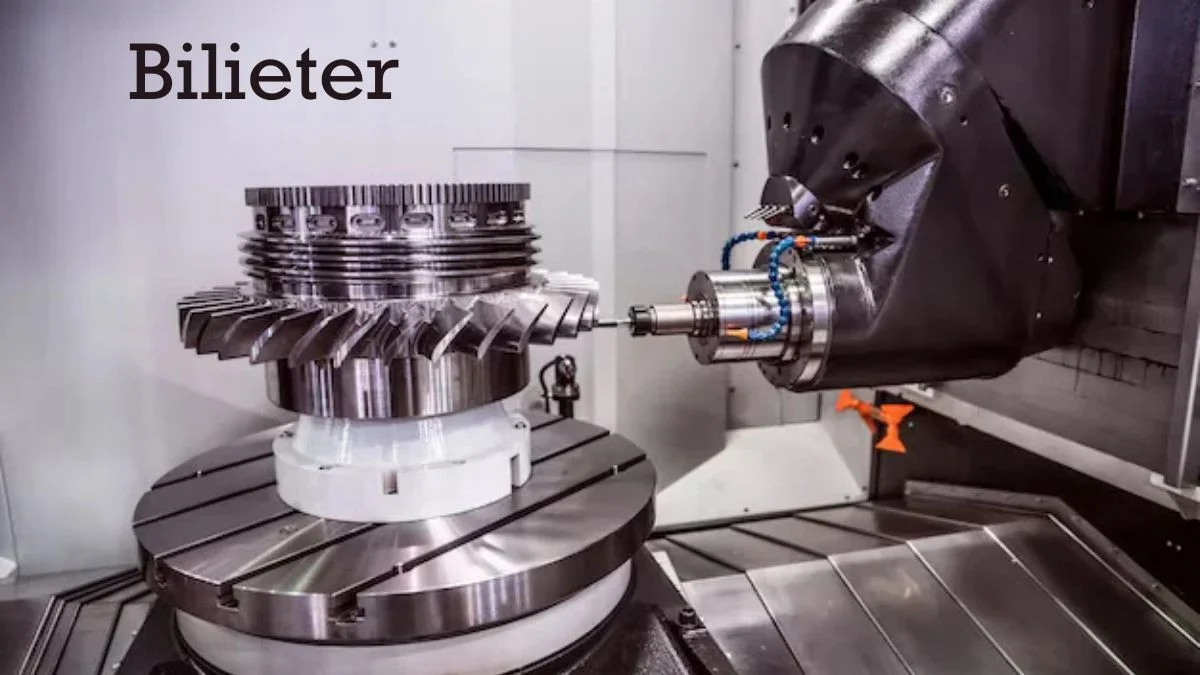
Bilieter’s operational framework likely centers on multi-axis CNC machining — specifically 4-axis and 5-axis milling — enabling the production of complex geometries that would otherwise require multiple setups, introducing cumulative error and extended lead times.
- 5-axis simultaneous machining for complex prismatic components
- Swiss-type turning for small-diameter, high-precision turned parts
- High-speed machining (HSM) with adaptive toolpath strategies
- EDM (Electrical Discharge Machining) for hardened-material precision
2.2 Quality Management & Metrology
Precision is only as credible as its measurement. Bilieter’s quality ecosystem likely incorporates coordinate measuring machines (CMM), optical comparators, and surface profilometers to validate each component against GD&T (Geometric Dimensioning and Tolerancing) specifications.
- CMM-verified dimensional inspection to sub-micron accuracy
- ISO 9001 and likely AS9100 / ISO 13485 quality framework alignment
- Statistical Process Control (SPC) for real-time process monitoring
- First Article Inspection (FAI) protocols on all new part families
3. The Bilieter 7-Step Precision Method (Information Gain Framework)
To provide a structured lens for understanding Bilieter’s likely operational approach, we propose the Bilieter 7-Step Precision Method — a conceptual framework synthesizing best practices from precision machining excellence programs:
- Material Qualification — Certifying raw stock against mill certifications and internal hardness/composition standards.
- Design for Manufacturability (DFM) Review — Collaborative engineering review to optimize features for machinability without compromising function.
- Toolpath Simulation — Virtual machining via CAM software (e.g., Mastercam, Hypermill) to detect collisions, optimize feeds/speeds, and validate cycle times.
- First-Off Verification — Dimensional validation of the initial part against full GD&T callouts before batch production commences.
- In-Process Gauging — Automated or manual mid-cycle measurement to catch drift before scrap is generated.
- Final CMM Inspection — Full 3D measurement of critical features on a statistically representative sample per AQL standards.
- Traceability & Documentation — Serialized job travellers, inspection records, and material certs archived for full audit-trail compliance.
This framework, while conceptual, mirrors the operational DNA that precision-focused organizations likely embed into their production systems. Bilieter’s application of such a methodology could explain its reportedly consistent delivery performance and low nonconformance rates.
4. Industries Served: Where Bilieter’s Precision Makes a Difference
| Industry Sector | Typical Components | Key Standard |
| Aerospace & Defense | Structural brackets, actuator housings | AS9100 Rev D |
| Medical Devices | Implant components, surgical instruments | ISO 13485 |
| Automotive / EV | Transmission parts, battery connectors | IATF 16949 |
| Industrial Automation | Precision shafts, encoder housings | ISO 9001 |
| Energy / Oil & Gas | Valve bodies, pump components | API Q1 |
5. Technology & Innovation: Bilieter’s Forward-Looking Edge
5.1 Digital Manufacturing Integration
Modern precision machining firms are increasingly adopting Industry 4.0 principles. Bilieter’s technological trajectory likely involves the integration of connected CNC machines feeding real-time data into Manufacturing Execution Systems (MES), enabling predictive maintenance, OEE (Overall Equipment Effectiveness) dashboards, and closed-loop quality feedback.
Research indicates that shops embracing digital connectivity can reduce unplanned downtime by a meaningful percentage — potentially 15–25% — while simultaneously improving first-pass yield rates. From a conceptual perspective, Bilieter’s adoption of such infrastructure could represent a significant operational differentiator.
5.2 Automation & Robotics
Lights-out machining — the capacity to run unattended production shifts — is increasingly a benchmark of operational maturity. Bilieter likely employs robotic part-loading systems, automated pallet changers, and vision-guided inspection cells to maximize spindle utilization beyond traditional single-shift operations.
6. Community & Collaboration: The Bilieter Ecosystem
What likely distinguishes the best precision machining brands from transactional suppliers is their approach to partnership. Bilieter’s community model probably operates on a co-development philosophy — engaging customers early in the product lifecycle to solve manufacturability challenges before they become costly production problems.
Engineers and procurement professionals who engage with Bilieter likely find a team that speaks the language of GD&T, stack-up analysis, and design trade-offs fluently. This collaborative posture tends to produce better outcomes: tighter tolerances achieved at lower cost, shorter lead times, and reduced engineering change orders (ECOs).
For those looking to explore partnership or collaboration with Bilieter, industry trade events such as EMO Hannover, IMTS Chicago, and regional Swiss precision manufacturing forums represent natural entry points where such firms typically maintain a visible presence.
7. Why Bilieter Now? Industry Tailwinds in 2026
Several macro-level trends make 2026 a particularly significant year for precision machining leaders like Bilieter:
- Nearshoring & Supply Chain Resilience: Post-pandemic restructuring is driving OEMs to repatriate precision component sourcing closer to home markets, benefiting established European and North American precision shops.
- EV & Aerospace Supercycle: The concurrent growth of electric vehicles and next-generation aircraft programs is generating sustained demand for complex, tight-tolerance machined components.
- Medical Device Expansion: Aging demographics globally are accelerating demand for orthopedic implants and minimally invasive surgical tools — both precision-machining-intensive categories.
- Skilled Labor Scarcity: As master machinists retire, firms with strong automation and documented process knowledge (like Bilieter likely possesses) will capture disproportionate market share.
8. Summary Checklist: What to Look for in a Bilieter-Class Partner
When evaluating whether a precision machining partner meets Bilieter-level standards, consider the following criteria:
- Multi-axis CNC capabilities (4-axis and 5-axis minimum)
- Traceable metrology program with CMM and SPC
- Relevant quality certifications (ISO 9001, AS9100, ISO 13485)
- DFM collaboration offered at design stage
- Automation and lights-out manufacturing capacity
- Documented First Article Inspection process
- Industry 4.0 / digital manufacturing integration
- Strong reference base in target industry sector